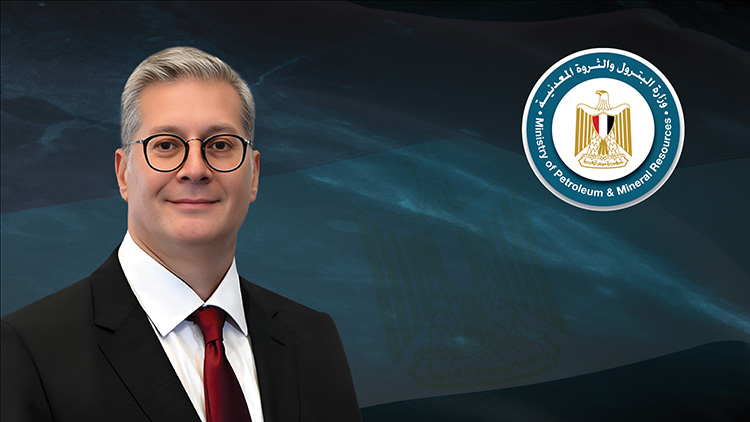
Your Excellency, could you outline the Ministry’s long-term strategic vision for Egypt’s energy landscape, and how this vision is shaping the sector’s transformation toward stability, competitiveness, and sustainable growth?
Egypt’s energy sector is not advancing by coincidence; it is progressing under a clear national vision designed to shift the country from reactive policy cycles toward a long-term framework of stability, competitiveness, and sustainable value creation. This transformation reflects a deliberate, state-led strategic decision to rebuild the sector’s foundations—not in response to immediate challenges, but in anticipation of future opportunities.
Today, the sector no longer reacts to external fluctuations; it operates according to an internal compass grounded in institutional coordination, investor confidence, and the efficient utilization of national resources. This marks a decisive transition toward a resilient, investment-driven, and forward-looking energy system that contributes directly to Egypt’s economic and industrial growth.
From the outset, it was recognized that true energy security is not defined by production volumes alone, but by an integrated framework in which every molecule extracted, processed, or exported strengthens national resilience and advances sustainable development.
This framework is anchored in six strategic pillars that guide the Ministry of Petroleum and Mineral Resources in fulfilling its mandate: securing domestic supply through exploration and production, maximizing value through refining and petrochemicals, unlocking the mining sector as a future industrial growth engine, aligning with the national energy mix strategy in partnership with the electricity sector, enhancing Egypt’s attractiveness and predictability as an investment destination, and positioning the country as a regional platform for energy connectivity and trade.
Together, these pillars form the operational foundation of the Ministry’s vision, shaping every reform undertaken, every agreement concluded, and every project implemented. They ensure that Egypt’s energy transformation remains strategic in direction, sustainable in impact, and global in reach.
Egypt has witnessed a remarkable acceleration in upstream activity, marked by the launch of new bid rounds and the signing of exploration and production agreements. In this context, how do you assess the current E&P landscape, and what strategic measures, regulatory reforms, and investment incentives are being implemented to further accelerate new discoveries?
This progress is not coincidental; it is the result of a deliberate and coherent national strategy to position Egypt as a competitive and attractive investment destination in the global energy sector. Over the past year, the Ministry of Petroleum and Mineral Resources has pursued a structured transformation under the “Reforming Egypt’s Oil and Gas Sector” framework. This comprehensive reform agenda has modernized the investment climate, strengthened contractual and regulatory frameworks, enhanced financial sustainability, and reinforced the confidence of international partners. It has focused on financial restructuring, progressive energy pricing mechanisms, modernized bid round models, and targeted incentives for incremental production all within a framework that guarantees transparency, predictability, and long-term investment stability.
These measures have been translated into tangible results across the upstream value chain. Egypt’s exploration momentum has reached an unprecedented pace, reaffirming the geological richness and multi-basin potential of the country. In the Mediterranean, five new offshore discoveries have consolidated Egypt’s standing within the Eastern Mediterranean basin, while the Western Desert continues to demonstrate its resilience as a prolific oil province, with 55 new discoveries recorded during the past year. Nationwide, exploration activity between July 2024 and August 2025 resulted in 67 new discoveries, underscoring both the diversity of Egypt’s hydrocarbon basins and the technical efficiency and operational discipline of its national and international partners.
Building on this momentum, the sector is now transitioning into a sustained drilling and development phase anchored by a multi-year exploration roadmap designed to ensure continuity, sustainability, and production growth. The forward plan includes the drilling of approximately 480 exploratory wells over the next five years, representing investments exceeding $5.7 billion.
At the same time, Egypt’s bid round strategy has evolved from a periodic licensing process into a structured, continuous, and data-driven market mechanism. Through the Egypt Upstream Gateway (EUG), the Ministry has fully digitalized access to geological and seismic data, replacing traditional licensing models with a modern, transparent, and interactive platform that enables investors to efficiently assess exploration opportunities. This transformation has already resulted in the award of 51 exploration blocks, attracting minimum investments of about $1.2 billion. Complementing this approach, the Ministry has prioritized the enhancement of subsurface intelligence through large-scale Ocean Bottom Node seismic campaigns conducted by the SLB/Viridien consortium, covering more than 95,000 square kilometers in the Eastern Mediterranean. These advanced surveys are redefining geological understanding of Egypt’s offshore basins. Parallel 2D and 3D seismic programs are also underway in the Red Sea and onshore territories, contributing to the creation of a modern, unified national geological database. This initiative represents not only data acquisition but a strategic investment in Egypt’s geological sovereignty ensuring that the nation’s resource base is fully mapped, efficiently developed, and optimally monetized for decades to come.
Equally significant is the renewed strength of Egypt’s partnership model. Over the past year, 21 new exploration and production agreements have been signed with leading international companies including Eni, BP, Shell, and Arcius Energy representing total investments exceeding $1.1 billion. These agreements go beyond capital commitments; they reflect deeper alignment in exploration planning, field development, and production optimization. BP has announced plans to invest $5 billion over the next five years, beginning with a five-well drilling campaign in the Mediterranean, while Eni’s five-year plan includes nearly $8 billion of new investments. Such commitments reflect the strong confidence Egypt continues to enjoy as a stable and promising energy destination.
By mid-2025, these collective efforts culminated in reversing the natural gas production decline trend a major milestone that underscores the effectiveness of the Ministry’s near-field development incentives, accelerated tie-in programs, and performance enhancement measures. These initiatives have maintained production levels from existing fields while seamlessly integrating new discoveries into the network. Today, Egypt’s production strategy is defined not by volume alone, but by stability ensuring a reliable domestic supply, sustaining export commitments, and consolidating the country’s position as a trusted regional gas partner and a key contributor to global energy security.
How does the Ministry plan to leverage Egypt’s world class LNG facilities in Idku and Damietta to unlock new commercial opportunities, whether by expanding processing capacity, enhancing regional gas trading, or deepening partnerships with neighboring producers?
Egypt today possesses one of the most extensive and advanced natural gas infrastructures in the region. This integrated network encompasses two world-class natural gas liquefication facilities at Idku and Damietta, the only such plants currently operating in the Eastern Mediterranean, alongside an extensive national pipeline grid and multiple gas processing plants distributed across the country.
This comprehensive infrastructure serves as a strategic foundation for the next phase of regional energy growth. It offers incoming investors a fully developed platform that significantly reduces development timelines and transportation costs, enabling the efficient monetization of resources and the rapid delivery of new production to market.
Beyond meeting domestic requirements, Egypt’s gas infrastructure is positioning the country as the principal gateway for Eastern Mediterranean gas to global markets. By leveraging its LNG capacity, Egypt enables gas produced in neighboring countries to be processed and exported through its facilities, transforming regional cooperation into tangible economic value for all partners.
This model ensures that discoveries across the wider Eastern Mediterranean can reach international markets without the need for additional, capital-intensive export infrastructure. At the same time, it reinforces Egypt’s role as a reliable regional energy hub, one that bridges production and demand, enhances market integration, and contributes to the stability and security of global energy supplies
How is Egypt planning to position itself as a competitive and attractive destination for refining and petrochemical investments, to maximize the value from hydrocarbon resources?
Egypt has entered a new phase of industrial modernization aimed at transforming the structure and efficiency of its energy value chain. Major refinery upgrade and expansion projects are reshaping the national refining profile from traditional processing units into a modern, high-efficiency network aligned with international product standards and the country’s evolving market requirements. This transformation strengthens energy security, reduces reliance on imported petroleum products, and supports Egypt’s transition toward cleaner and more sustainable fuels.
In parallel, Egypt’s petrochemical strategy is moving decisively from exporting raw energy molecules to exporting industrial value. The national plan targets doubling petrochemical production to reach approximately $4.2 billion by 2030, marking a structural shift in how the sector contributes to economic growth, technology transfer, and value creation. The downstream industry is thus becoming a central engine for industrial diversification and long-term economic resilience.
Over the past year, the Ministry has overseen tangible increases in refinery output and the completion of key infrastructure projects that have reinforced domestic supply chains and reduced import dependence. For example, the MIDOR Refinery is advancing its modernization program to expand operating capacity, positioning it among the most advanced refineries in Africa and the Mediterranean. The facility now supplies a high percent of Egypt’s domestic consumption reflecting an important contribution to meeting national demand and strengthening Egypt’s refined-product balance.
Furthermore, Egypt is working collaboratively with its international partners to launch several petrochemical projects in the coming years, all driven by strong state support and guided by a national vision aimed at maximizing the value added from the country’s natural resources. The Ministry is also working extensively and actively to materialize these projects, ensuring their timely implementation and alignment with Egypt’s downstream expansion strategy.
The signing of the Host Government Agreement for Cyprus’s Cronos field and the other agreements signed during the Eastern Mediterranean Energy Conference (EMC) 2025, in addition to the Memorandum of Understanding for the Aphrodite field marked an important milestone in Eastern Mediterranean energy cooperation. How do these agreements advance Egypt’s vision of becoming a regional energy hub?
Egypt’s regional role has evolved into a fully strategic function. The country has successfully transitioned from serving as an energy transit corridor to becoming a fully integrated gas hub that connects the Eastern Mediterranean’s resources with global markets.
This transformation has been enabled by Egypt’s world-class LNG infrastructure, extensive pipeline network, and a series of bilateral and regional cooperation frameworks, most notably with the Republic of Cyprus. The Host Government Agreement for the Cronos field and the Memorandum of Understanding for the Aphrodite field, both signed earlier this year, represent key milestones that translate regional cooperation into tangible, mutually beneficial projects.
These agreements provide a cost-effective solution for developing Cypriot gas resources and delivering them to international markets. This model offers a true win–win partnership by reducing development costs and timelines for operators while consolidating Egypt’s position as the natural export gateway for Eastern Mediterranean gas.
Beyond their commercial and logistical value, these partnerships carry broader significance, as Egypt now plays a pivotal role in coordinating regional energy flows in a manner that avoids unnecessary duplication of infrastructure and accelerates cross-border resource monetization. In essence, Egypt’s gas hub vision extends beyond physical infrastructure. It embodies a framework of regional integration and shared prosperity positioning Egypt as a trusted, strategic connector between regional producers and global consumers.