The EGYPES 2025 Sustainability in Energy Conference served as a vital forum for bringing together top experts in climate and energy transformation to examine and refine strategies aimed at accelerating decarbonization.
This occasion unfolded under the central theme “Driving Realistic Decarbonization Targets by 2030,” with discussions emphasizing the concrete steps that need to be taken in the coming decade to expedite the transition to greener energy sources and achieve essential decarbonization milestones by 2030.
The event witnessed an insightful keynote address by Yasmine Fouad, Egypt’s Minister of Environment, who underscored the country’s dedication to making sustainable energy solutions more affordable, accessible, and efficient amid the complex challenges posed by a rapidly changing world.
Highlighting the progress made in environmental reporting, she stated “On the 31st of December in 2024, we submitted our first transparency report to the climate secretariat. For the oil and gas sector, we have achieved a 57% [harmful emissions] reduction through the flaring reduction technology and reusing that once again in the energy production in the same sector.”
Philip Whittaker, Executive Vice President of Business Services at Harbour Energy, reiterated his company’s dedication to addressing the world’s growing energy demands while upholding safety, efficiency, and sustainability—particularly in Egypt.
“We actively work to reduce our emissions and we are investing heavily in carbon capture and storage,” he said. Whittaker also emphasized that his company’s collaboration with EGAS’s achievement stating “Our team in Egypt, working alongside our joint venture partner EGAS, has been dedicated to flaring reduction. We are proud to announce that we are the first company in Egypt to have implemented a zero-flaring project at Disouq, completely eliminating routine flaring at the site.”
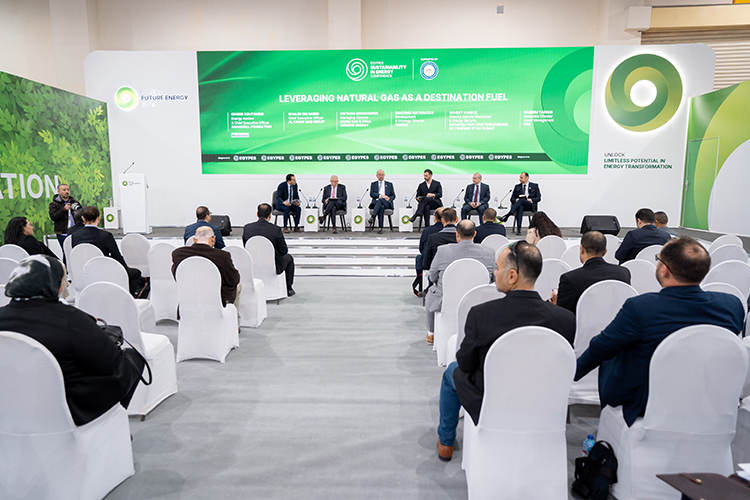
The conference included a panel discussion titled “Leveraging Natural Gas as a Destination Fuel”, gathered prominent industry leaders, including Dietmar Siersdorfer, Managing Director of Middle East and Africa in Siemens Energy; Khaled Bin Saeed, Chief Executive Officer, Al Fanar Gas Group; Bassem Tadros, Associate Director of Asset Management at XRG; Giacomo Matarazzo, Development and Strategy Director at Teréga; and Sohbet Karbuz, Director at Natural Resources and Energy Security Organization at Méditerranéenne de lʼEnergie et du Climat.
Discussions centered on the integral role of natural gas as a bridge toward a low-carbon future, examining its viability as a cleaner alternative to traditional fossil fuels.
Another critical panel session, “Eliminating Methane Emissions, Reducing Flaring, and Electrifying Operations,” focused on industry-wide initiatives aimed at slashing methane emissions, minimizing flaring, and incorporating renewable energy sources into oil and gas exploration.
Among the speakers Ilaria Parrella, Emissions Abatement, Executive Director of Climate Technology Solutions at Baker Hughes; Giorgi Bibineishvili, Head of Upstream Georgian Oil and Gas Corporation; Khalid Al Dossery, Vice President, Energy Transition & Sustainability TAQA; and Ahmed Osama General Manager of the Energy Efficiency Department at the Egyptian Ministry of Petroleum and Mineral Resources.
Ahmed Osama highlighted Egypt’s forward-thinking approach in tackling emissions: “I believe the dialogue and the narrative should shift towards not eliminating energy sources, not picking winners and losers, and not verifying any specific source, but to say that we need to produce more energy, but to shift the focus to reducing emissions,” he told attendees. “I believe this is very much the direction we receive and the vision of our minister, His Excellency Engineer Karim [Badawi].”
Osama also noted “Digital transformation has been a key part of the Ministry of Petroleum and Mineral Resources’ vision since quite some time. This is also continuing moving forward,” explaining how Egypt is deploying new technologies for digital transformation in the local energy sector.
He highlighted, “December [2024] was the first time [we] employed drones [to] measure methane in one of our sites.” He explained that cameras mounted on those drones give more accurate methane measurements.
Additionally, a session titled “Diversifying into New Energies and Enabling Clean Technologies,” delved into the diversification of energy sources and the increasing role of technology in reducing dependence on fossil fuels.
The discussion featured Hesham Zubari, Chief AI & Innovation Officer at Dragon Oil; Guillaume Verhaeghe, New Energy Director at MENA SLB New Energy; and Antony Watson, Chief Executive Officer for Ras Ghareb Wind Energy, who shared insights on the integration of advanced technologies and renewable energy solutions into existing energy frameworks.
Another panel, “Demonstrating Sustainability and Emissions Reduction through Effective ESG Reporting,” explored the growing importance of Environmental, Social, and Governance (ESG) reporting in ensuring sustainable business practices and tracking emissions reduction progress.
Speakers were Manal Hassan, Chief Sustainability Officer at El Sewedy Electric; Daxita Rajcoomar, Chief Sustainability Officer for Africa, Middle East and Asia at ENGIE; Hesham Yehia, Sustainability Director at Fertiglobe; Janka OʼBrien Sustainability Director at MEA Emerson; Vito Saluto, Head of ESG AMEA Power; Fernando Kalligas Senior Director of Corporate Affairs DESFA.
Discussions underscored how ESG frameworks are being strengthened to enhance corporate sustainability accountability and promote transparent reporting within the energy sector.