On the inaugural day of the Egypt Energy Show (EGYPES 2025), the CLIMATECH Challenge was launched as a pioneering initiative designed to empower climate tech startups to expand their operations across the MENA region. This forward-thinking challenge aims to create a robust platform for emerging companies, enabling them to transform groundbreaking low-carbon ideas into market-ready, commercially viable ventures.
The event commenced with an engaging keynote address by Alexandra Sdoukou, Greece’s Deputy Minister of Environment and Energy, who said “It is very positive that today we have already deployed many technologies, wind, solar, smart grids, energy storage, electric vehicles, green hydrogen. But the truth is that 33% of the greenhouse gas emission reductions expected by 2050 will come from technologies that are not yet on the market, according to the International Energy Agency.”
Sdoukou stressed the need to develop new climate technologies in the MENA region and to be distributed across the globe. “A few days ago, I read a report about venture capital in the climate tech sector here in this region. And what this report found was that since 2010, only 49 new climate tech startups have been founded here in MENA region, compared to almost 2,950 in Europe, and compared to 2,000 in the U.S. and Canada.”
The opening session, titled “Creating a Thriving Climate Tech Startup Hub in the MENA Region,” delved into the primary obstacles hindering increased private investment in climate tech startups across MENA while also underscoring the region’s emergence as a rising hub for innovative ventures. Karima El Hakim, Country Director at Plug and Play Tech Center, focused on the issue of inadequate financing. She explained “As early-stage investors, we go in pre-seed or seed stage, which means this might be the first round of investments that the company is making. We only investigate tech companies and not tech-enabled companies, so really looking at technology to scale.”
In a similar vein, Amal Enan, Partner at 500 Global, stressed the crucial role that venture capital plays in absorbing early-stage risks. She noted, “There will be a lot of innovation that fails, and we have to accept that fails. VC is capable of doing that.” Enan further underscored the importance of forming partnerships—especially with government entities—to jointly shoulder the risks alongside venture capital investors.
She elaborated further by saying, “We want to partner with governments who will take on the regulatory risk with us. So, there is still a lot of regulatory risks out there that need to be addressed by markets, by sectors, and I think governments are better positioned to see where this is going.”
Ayman Ismail, Founding Director at AUC Venture Lab, shared insights into successful collaborative models that can facilitate scaling and encourage the creation of additional startups in the MENA region. He highlighted several models, including venture clienting, open innovation, and strategic partnerships with universities, as key approaches to fostering a more vibrant startup ecosystem.
The second panel, titled “Accelerating Decarbonization through Energy Corporations and Climate Tech Startup Partnerships,” examined the current landscape of collaboration among startups and discussed a range of strategies for establishing partnerships that could expedite the introduction of new climate technologies into the market.
Fabio Fritelli, the Managing Director NEXTCHEM, discussed how his company is collaborating with startups. “We are in between [the] startups and the clients to ensure and assure the clients that technology is proving to work at a small scale and can work at the industrial scale.”
Additionally, Youssef Salem, the Chief Financial Officer of ADNOC Drilling, mentioned how his company is engaging in partnerships with technological startups, stating that they have three technology tracks. “One is our subsidiary EnerSol Energy Solutions, which basically acts as a buyout vehicle to buy late-stage technology companies in the energy space. The second track is working with accelerators and incubators. The third track is we have a sister AI company called AIQ, which is basically a partnership between ADNOC and Presight.”
In turn, Hüseyin Çiloğlu, Chief Executive Officer of PiKARE SKYSOURCE, showcased the challenges that may face, as a startup, when dealing with the energy corporations. “You need to first understand your unique value propositions well from a startup point of view. And then, actually, if it fits with the company’s own objectives. So, this is crucial and you need to understand,” he said.
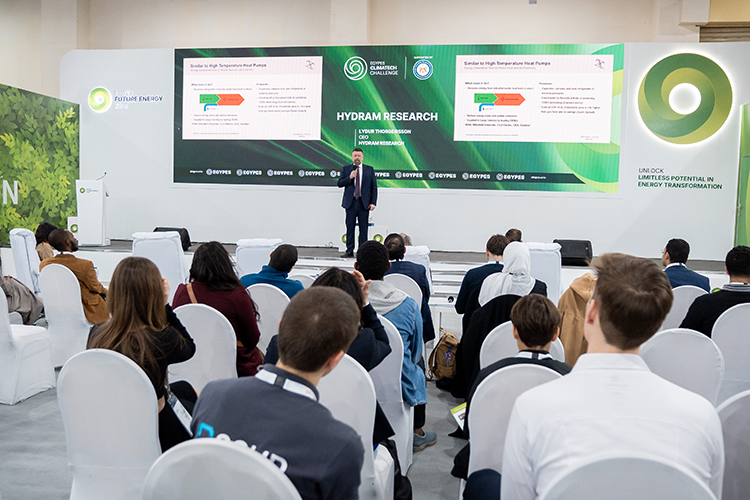
Sponsored by Petrojet, the event also showcased five startup companies presenting their cutting-edge technological solutions and innovative approaches designed to support the adoption of clean and renewable energy. These startups were NoorNation, Hydram Research, Helical Fusion, kraftwerk BOX GmbH, and SOLID.
In conclusion, Alaa El Batal, the First Undersecretary for Energy Efficiency and Climate & Safety at the Ministry of Petroleum and Mineral Resources, wrapped up the conference by honoring two outstanding innovators. Helical Fusion received the People’s Choice Award, while Kraftwerk Box was bestowed with the CLIMATECH Challenge Award, both in recognition of their groundbreaking contributions to advancing clean power and renewable energy solutions.