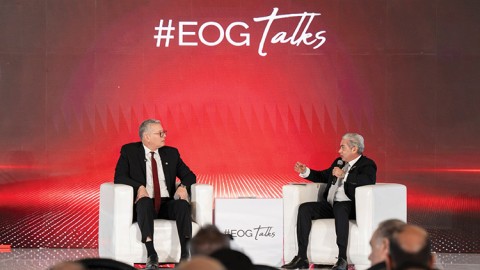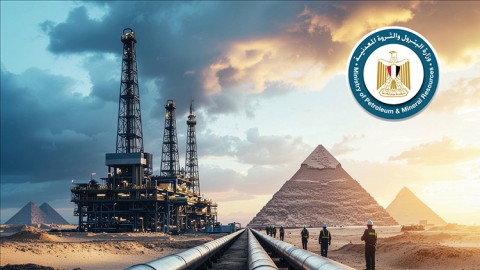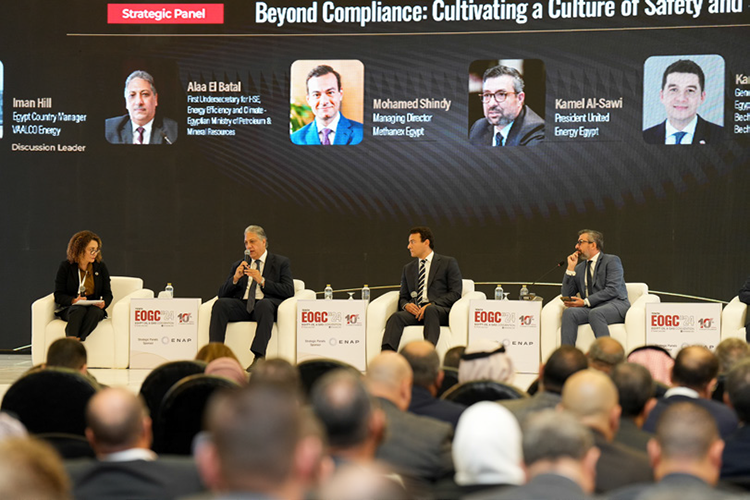
The 10th annual Egypt Oil & Gas Convention (EOGC 2024) commenced with an impactful focus on collaboration and innovation within the oil and gas sector. The event brought together industry leaders to discuss critical issues shaping the future of Egypt’s energy sector. Their insights highlighted several key topics including the critical need for collaboration between the private and public sectors as well as the need to empower the workforce and other aspects that lead to boosting operational efficiency and maximizing production in Egypt’s rich oil and gas landscape.
Synergistic Success: Forging Collaborative Partnership
The 10th annual Egypt Oil & Gas Convention (EOGC 2024) kicked off with a panel discussion titled ‘Synergistic Success: Forging Collaborative Partnerships.’ The panel featured Dalia ElGabry, VP & Country Chair of Shell Egypt; Moataz Atef, Undersecretary of the Ministry of Petroleum and Mineral Resources (MoPMR) for the Technical Office and Official Spokesperson; Gustavo Guisolfo, General Manager of ENAP Sipetrol Egypt; and Wail Shaheen, Vice President of bp Egypt.
The session discussed collaboration between the private sector and the public sector in the Egyptian oil and gas industry to enhance operations and yield production. Atef explained that “Although [Egypt has] been in the oil and gas industry for decades, [the country] still has 61 blocks to award. So, the natural resources that [Egypt] has, they are huge and they require a lot of collaboration to get off the ground.”
On the other hand, Guisolfo explained that “The key expression in order to work together is integration and systemic analysis in order to go faster with our decision.”
Moreover, the distinguished industry leaders highlighted priorities to ensure efficient operations. ElGabry noted that “Once [the company] has the technical standard set-in place, [it] also needs to integrate systems to comply with regulations and keep pace with evolving technology. This is where [it] needs to have a genuine willingness to really collaborate.”
Meanwhile, Shaheen stated that “Once [the company] has a common cause to tackle the issues and problems [stakeholders] are all facing, then [the company] can start to think about how [it] can operationalize it.”
Beyond Compliance: Cultivating a Culture of Safety and Sustainability
EOGC 2024 further hosted a panel discussion titled ‘Beyond Compliance: Cultivating a Culture of Safety and Sustainability.’ The panel featured Iman Hill, Country Manager at Vaalco Energy Egypt; Alaa El Batal, First Undersecretary for HSE, Energy Efficiency and Climate at MoPMR; Kamel Al-Sawi, MiM, President at United Energy Egypt; Karim El-Dessouky, General Manager at Bechtel Oil, Gas, & Chemicals Egypt S.A.E. Vice President, Bechtel Overseas Corporation; as well as Mohamed Shindy, Managing Director at Methanex Corporation Egypt.
The panel discussed the importance of health, safety and environment (HSE) and safety practices in the workplace. El Batal explained that “MoPMR is very keen to embed HSE culture in the field and among [its] companies. It is very important because no doubt that HSE is a top priority for everyone.”
Additionally, El-Dessouky noted that “There is an ambition that the petroleum sector could lead something that could expand further to standardize safety working practices across Egypt as a whole and not only across the petroleum sector.”
The industry leaders further commended safety culture across the oil and gas sector. Hill pointed out that “Compliance is not only about doing things because [people in the industry] have to, but building a safety culture that is sustainable and actually encompasses ownership to the environment.”
On the other hand, Al-Sawi stated that “A strong safety culture always begins with the leadership’s commitment. Leaders should always talk about safety. They have to walk the talk, not only talking about it. They have to emphasize safety in all their decisions and actions so that their team can feel that they are very strict about safety and that it is part of their day-to-day business activities.”
Meanwhile, the panel also highlighted the importance of engagement and supervision to ensure safety. Shindy explained that “Engagement and supervision are critical for success in our culture, especially supervision with contractors that you’re not aware of or haven’t tried before.”
Data-Driven Decisions: Mitigating Risk, Maximizing Returns
The 10th edition of EOGC further featured a dynamic panel discussion titled “Data-Driven Decisions: Mitigating Risk, Maximizing Returns.” The panel brought together distinguished industry leaders: Khaled Salah El Din, Chairman Assistant for Information Technology & Digital Transformation at the MoPMR; Ali Rashid Al Jarwan, CEO of Dragon Oil; Greg McDaniel, Vice President of Egypt Assets and Country Manager at Apache Corporation; and Alan Linn, CEO of Cheiron Petroleum Corporation.
The panelists highlighted the importance of trust between partners, as well as sharing and obtaining data to ensure the right decisions are taken to drive success in the oil and gas sector. Al Jarwan stated that “After COVID time, [the company] found it useful to partner with a major service company and [it] trusted this company. [The two companies] became partners, and collaboratively [Dragon Oil] gave them all the reservoir models, geological, geophysical reservoir simulation.”
Meanwhile, McDaniel noted that “[Oil and Gas Companies] can find the right answers by properly analyzing the data for [their] stakeholders to make informed decisions.”
The panel discussion further delved into the role played by digital tools in the sector. Salah El Din explained that “Edge computing is used to validate data and ensure that all the data has integrity before moving to a central warehouse.”
Moreover, Linn stated that “One of the things that [Cheiron is] looking at right now is basically remote sensing on each one of [its] well heads. The reason why [they] want to do that is because [they] want to know every single one of [their] wells, what it’s doing at a moment in time so that [they] can target the visits if the well is down or if the well is underperforming.”
Driving Efficiency in Field Operations
The third panel of the convention entitled “Driving Efficiency in Field Operations” tackling how the companies along with the Ministry of Petroleum and Mineral Resources (MoPMR) try to deploy the new technology in elevating the efficiency of the operations.
The speakers of the panel session were Joey Deng, CEO, Huawei Digital Power Business Egypt, Ehab Ragaee, First Undersecretary for Production at Ministry of Petroleum and Mineral Resources – Egypt, Ivan Almeida, Upstream Venture Manager at ExxonMobil Egypt (upstream) Unlimited, Saif Baza, CEO Seaharvest Free Zone, and Sun Bao, Country General Manager North Petroleum International Company (NPIC).
Ragaee discussed how MoPMR is encouraging and seeking for applying new technological solutions among the sector especially in light of the decarbonization goals. “Our door is open to any new idea and any new technology. We will feel happy to help each other in meeting our goals, most notably what we need to do decrease CO2 emissions,” he said.
Additionally, Baza explained the need of interpreting data inventory as well as the need to be centralized among the international oil companies (IOCs) which enable standardization so everyone can use data anywhere. “The supply chain will just integrate technology and supply chain and the governance behind the supply chain and centralization. So, one of the things that need to be done is interpret the data,” Baza stated.
For his part, Deng presented Huawei’s progress in providing solutions that benefit the petroleum sector. “As Huawei, we are known as a digital company, so we are trying to combine the digital technology with electronic technology. That is why in Egypt we are focusing on the upstream in order to provide innovative solutions,” Deng mentioned.
For his part, Bao highlighted the technology capabilities in the sector and how it can optimize the sector noting “digitalization encourages development and is a key enabler to enhance efficiency for the sector.” In addition, Almeida offered interesting insights into effective methods the sector can use to enhance operational efficiency on the fields and at key assets.
Empowering the Workforce: Skills for the Future of Energy
EOGC 10th edition witnessed another fruitful panel discussion touching on “Empowering the Workforce: Skills for the Future of Energy” featuring the industry leaders, Eleanor Rowley, Managing Director Egypt Capricorn Energy PLC, Omar A. Nasser, Managing Director NPC SAZ, Sara Mortada, Engineering General Manager at SMD, and Wei Dong, Chief Representative, Africa Office Sinopec International Petroleum Service Corporation.
Rowley led the stimulating discussion focusing on fueling the sector’s human resources potential to perform with excellence in a competitive global economy. Furthermore, Mortada highlighted the crucial role of the technology adoption especially artificial intelligence (AI) which helps growing the businesses. She also noted to the necessary for interpreting the data by the young talents which helps make write decision.
“AI machine learning should be managed by young talents who already have digital transformation mindsets. That’s why they are very clever at connecting the dots and I guess the best proof for this is the launch of Energy Lens that was announced today by Egypt Oil & Gas. We’ve all seen that it was executed by a team of young talents,” she elaborated.
Dong shed light on the importance of including a new workforce to align with the developments that occur in the oil companies after adopting the energy transition to their business. He said, “We found with development of renewable energy, we needed to recruit newcomers, such as the people who could add electricity, who could add manufacturing and other uses and storage and the transportation of hydrogen and ammonia, for example.”
While Nasser talked about what are the skills that he focused on in his workforce especially his company is one of the small companies. He explained “for a smaller company, it is a bit different, you have less resources, and you need to deliver the same product.”
He elaborated that the competencies that they focus on are technical including geosciences, geology, geophysics, reservoir engineering and production optimization to deliver operational excellence. He also said that he has to make sure of having the right skills who are updated with the changes going on in the industry and are able to cope with these changes.
Elevating Service Excellence: Empowering Oil and Gas Service Providers
EOGC 10th edition was concluded with a great panel session titled “Elevating Service Excellence: Empowering Oil and Gas Service Providers” involving the industry leaders, Salah Abdelkerim, CEO of Egyptian General Petroleum Corporation (EGPC), Ahmed Azzam, Country Manager at Baker Hughes, Ismail El Kholy, Chairman at NESR Egypt, Osama ElShenoufy, North East Africa Sales Director at Weatherford, and Sherif Bayoumy, Managing Director Egypt, and East Mediterranean at SLB.
During the session Abdel Kerim emphasized the need for real cooperation between the international services providers and the EGPC, the need for having more investments as well as having research and development centers in Egypt. “We are expecting to have fruitful cooperation, especially with international service providers that have the needed technology and financial resources as well as the ability to transfer these technologies and ideas as they have more exposure,” he noted.
On his side, Azzam underlined the need to focus on holding workshops and transparency between the service provider and the operators to help raise the efficiency of the provided services and solutions, explaining “transparency can be realized through an open channel of communication between the service provider and the operators, by holding workshops and setting rules.”
Furthermore, ElShenoufy emphasized the importance of adopting AI and machine learning technologies in operations, as they have a positive impact on production that aligns with the focus of the MoPMR. He pointed out that “there is a lot of improvement that we can add to the Egyptian market. Having agnostic software that would help in providing the required support to office teams through interactions with IoT sensors and getting the real-time data monitored by the team in the office. These technologies can provide real-time data analysis and proposed solutions to enhance the production.”
EOGC 2024 not only served as a platform for dialogue among industry stakeholders but also aimed to foster a culture of innovation that aligns with global energy transitions. By bringing together leaders from various sectors, the convention sought to pave the way for a more resilient and efficient future for Egypt’s oil and gas industry.