Egypt will be the first Arab and African nation elected to lead the International Gas Union (IGU) after assuming its presidency of the union in 2028. This came as a majority of the IGU’s 94 Charter Members voted in favour of Egypt’s becoming the union’s vice president (2025–2028), consequently followed by a three-year presidency term (2028–2031).
Established in 1931, the IGU is a global non-profit organization that leads global efforts to position gas as a pillar of a secure, sustainable, and affordable energy future.
As the Egyptian Gas and Energy Association (EGEA) represents Egypt in the IGU, it will serve as a direct arm during the country’s leadership of the IGU.
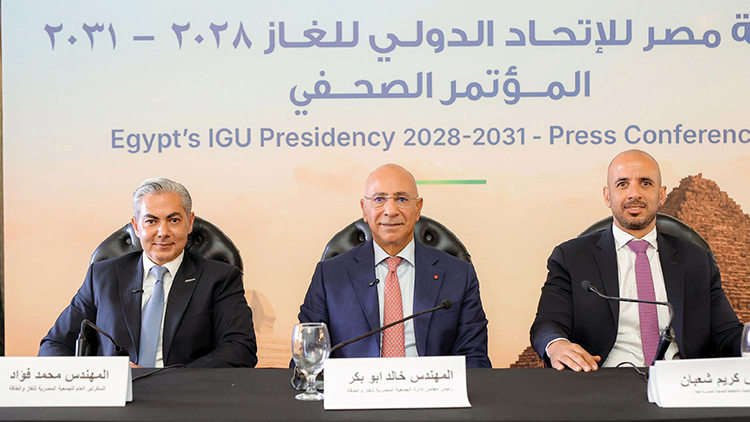
“Building on Egypt’s 50 years of experience in the gas industry across the full value chain and the EGEA’s active involvement in the IGU for the past 36 years, our comprehensive program and strategy enabled Egypt to become the first African and Middle Eastern nation to take the helm of the IGU,” said Eng. Cav. Khaled Abubakr, Vice President of IGU and Chairman of EGEA, during a press conference.
The press conference was part of a full-day event hosted by EGEA on June 22 at the Marriott Hotel in Cairo, during which Egypt’s plans to serve as vice president and later president of the International Gas Union (IGU) through 2031 were discussed
From Candidacy to Leadership
Mohamed Fouad, Secretary General of EGEA, and the Egyptian Presidency Team Director for the IGU, explained the strategy Egypt adopted to win the elections. The EGEA nominated candidates to lead the IGU presidency from 2028-2031 in February 2024. After winning the majority of the votes over Colombia in October 2024, the Egyptian team officially began its Vice Presidency term in May 2025 at the conclusion of the World Gas Conference 2025.
“We shaped a vision throughout the 12 months of preparation while considering the policies and needs of different regions to represent the whole globe”, said Fouad at the press conference.
Karim Shabaan, Vice Chair of IGU’s Coordination Committee, member of the Executive Committee of the IGU, and Head of the Strategy and Planning Committee of EGEA, said that EGEA then analyzed the main gas-related problems in different regions. It identified three key pillars underlying energy-related challenges: energy policies, energy security, and energy sustainability.
Charting the Road Ahead
During the one-day event, EGEA held its first advisory board meeting, where it convened industry leaders from the public and private sectors as well as international partners operating in Egypt’s energy and gas sector, to outline themes to integrate the IGU committees and working groups.
Abubakr began the meeting by reaffirming the association’s mission and outlining the advisory board’s mandate to guide, support, and elevate its initiatives within the IGU.
For his part, Fouad emphasized that the association’s involvement throughout phases of Egypt’s leadership of IGU centers on one key objective: alignment with various interests and agendas of several stakeholders within the industry.
The meeting addressed key priorities to focus on from the outlined themes, including the energy transition and decarbonization, energy security and supply optimization, market liberalization, and investment attraction.
A Night of Celebration and Recognition
EGEA hosted a reception at the end of the day, bringing together industry leaders, ministers, and ambassadors to celebrate Egypt’s six-year mandate in IGU 2025-2031.
During the reception, Abubakr, Shaaban, and Fouad addressed the attendees with a presentation, providing an overview of IGU’s role in the gas industry. “The IGU advocates for the full spectrum of gases, and this includes now natural gas, low carbon, decarbonization, and renewables, including hydrogen, either green hydrogen or blue hydrogen,” said Abubakr.
Within that context, Abubakr reflected on the major events that IGU hosted, including the World Gas Conference, expected to be held in Egypt in 2031, which marks the IGU centenary anniversary. Furthermore, he noted, “A major part of our activity of the IGU is global advocacy. This means getting involved with the G7 and the G20 members in their meetings, to shape and have a balanced dialogue in terms of energy, because sometimes it is a pure discussion about energy transition, and it does not take into consideration energy poverty in sub-Saharan Africa, or in South America, or different parts of Southeast Asia, which is extremely important to make energy both affordable and secure for people, build the economy, and ensure social growth,”.
Touching on IGU’s organizational structure, Abubakr explained that it includes a secretariat as well as six regional coordinators, where Egypt represented the African region for the past six years. It also comprises committees and task forces that take on certain specialties every three years to address particular global challenges and specific issues like artificial intelligence.
For his part, Shabaan highlighted key themes and strategic initiatives that EGEA plans to focus on during Egypt’s Presidency. “Methane leakage is a big topic that can have a needle-mover effect on the entire industry. [Questions to ask include] How can we develop carbon capture and utilization to reduce the CO2 footprint of our gas industry? How do we develop new fuels to supplement renewable fuels into the energy mix?”
In the same context, Fouad underscored the importance of aligning scopes and working together in harmony in order to achieve a sustainable future. “The word ‘sustainability’ might in a way have been hijacked. Today, when we hear the word sustainability, we think green, renewable, and environmentally friendly. But for me, and for all of us, it is not only ‘green’. It is ‘affordable’ and ‘available’. That is sustainability,” he said.
The objective includes energy security, sustainability, affordability, and aligning with various needs to ensure a sustainable future, according to Fouad adding that working in alignment with the program and vision of Italy, the current IGU president, is equally as important to ensure the efficiency of Egypt’s leadership in terms of creating a sustainable program for the long run and not just during the three years of IGU Presidency.
For his part, Shabaan stated that the biggest challenge in the process of aligning the same priorities lies in IGU’s global representation, as it encompasses over 100 members and multinational gas associations across the globe.
“In our term, we plan to drive the committee work over the three key themes: energy security, affordability, and transition, to ensure that as a presidential team, supported by the IGU secretary, we represent the global IGU members not only focus on part of the organization and neglect the rest,” Shabaan said.
Underscoring the issue of energy security in the black continent, Shabaan added, “In Africa, we believe basic energy security is a must. Many parts of the continent still lack basic energy requirements. If you look at even how people cook in many areas where we operate, it would surprise you. The number one cause of death in Africa now is suffocation from the use of charcoal at home. So, a large part of our program will be about financing projects and linking them with the infrastructure needs of the continent.”
Looking forward
Former Minister of Petroleum and Mineral Resources Tarek El Molla delivered a brief address at the conclusion of the event. “I would like to congratulate Egypt on this important new position in the IGU—its presidency. It is not just recognition for Engineer Khaled alone, but a major success for all of Egypt,” he said. “Together, we have positioned Egypt as a key gas player, not only regionally, but globally.” He noted that Egypt assuming this new role reflects global recognition of its leadership in the industry.
The event came to a close with an acknowledgement of prominent national figures for their exceptional service and leadership to Egypt’s development and the energy sector at large. Among those honored were HE Tarek El Molla, Advisor Shahinaz Abu Sarea, on behalf of Foreign Affairs and Immigration Minister HE Badr Abdel Atti; Alaa Ezz, Secretary General and CEO of the Federation of Egyptian Chambers of Commerce (FEDCOC); and HE Osama Mobarez, Secretary General of the East Mediterranean Gas Forum (EMGF).